The humble golden kee changs that are extraordinary
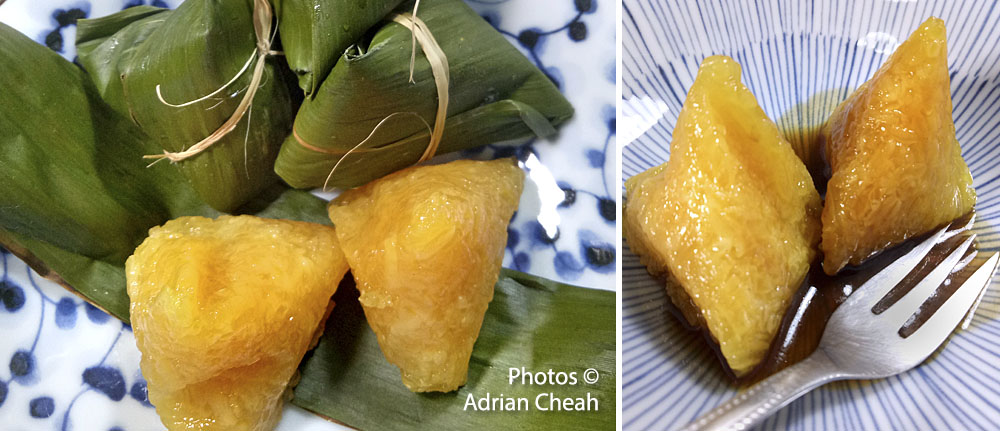
The preparation of kee chang (alkaline dumplings) commences a week ahead. It entails the painstaking task of separating jasmine rice grains from a mound of glutinous rice, a process that demands both time and patience. This laborious undertaking is essential to achieve the desired translucent appearance of the dumplings. Even the slightest presence of rice grains would mar the enchanting allure of the kee chang's transparency.

As a young child, I vividly remember helping with this arduous task of sifting through the rice—a practice my Mum affectionately called “pilih the pulut". Back then, I could not understand why such painstaking effort was necessary, as everything would eventually be gobbled up anyway. However, Mum would firmly dismiss our arguments, unwavering in her commitment to quality and tradition.
Today, I realise how deeply her values have shaped me. I, too, have inherited her insistence on doing things properly and never compromising on quality. Perhaps the greatest irony is that my own daughter now echoes the very same arguments I once made to Mum.

The majority of the photographs featured in this story were taken during a chang-making class conducted by Lily Wong for the Ladies' Circle of the State Chinese (Penang) Association. That day, Lily shared her expertise in the art of chang-making, including both bak chang and kee chang. While some culinary enthusiasts incorporate a small amount of red bean paste in their kee chang, Lily prefers to enhance hers with one or two plump kidney beans. Mum, however, preferred to leave out both the red bean paste and kidney beans. Participants were fortunate to enjoy a hands-on experience, actively taking part in the creation of these petite dumplings. It was an afternoon filled with laughter and camaraderie, rekindling fond memories when Mum would lovingly prepare these changs.
With remarkable dexterity, Mum’s hands made everything look effortless, moving with lightning speed. It was a necessity, given the considerable quantity she had to produce to satisfy our voracious appetites. Eager to learn, I joined in whenever I could, immersing myself in the art of kee chang-making under her patient guidance. Today, the skills and knowledge I possess stand as a testament to her invaluable teachings.
Recently, Mum received a batch of kee chang and could not help but express her disappointment. The dumplings clung stubbornly to the bamboo leaves, showing an undesirable stickiness and a lack of the prized “kiew” (Hokkien for springy and chewy) texture. In the good old days, heaven forbid that such low-grade kee chang would be shared, as it could potentially tarnish one’s reputation indefinitely. Within the fabric of local Chinese culture, the concept of “saving face” carries great significance, particularly in tight-knit communities like Penang. In a place where nearly everyone is connected through familial ties or acquaintances, news travels fast.
Although Mum has stopped making kee chang for decades, she could not resist sharing her insights on the matter. With a hint of nostalgia, she remarked, “Kee chang may consist of just two ingredients—pulut (glutinous rice) and kee chooi (lye water)—but even with such limited room for variation, the methods used to make it can differ significantly. The quality of kee chang hinges on its translucency and ‘kiew’ texture. To achieve these qualities, one must use good-quality pulut. It is important to note that not all pulut is the same, given the wide variety available in the market. When purchasing pulut, it is advisable to opt for rice imported from Thailand and to obtain it from a trusted source.”

The kee chang crafted by Mum possessed an exquisite charm—they did not stick to the leaves and formed dainty, well-shaped parcels. Each dumpling held its structure, with a soft and enticingly “kiew” texture. When held up to the light, they gleamed like radiant suk-kissed gems.
One of the secrets to a flawless kee chang lies in determining the precise amount of glutinous rice to encase within each parcel. It is crucial to allow sufficient space for the rice to expand during cooking. Mum often emphasised that an uncooked kee chang should exhibit a gentle jiggle when lightly shaken. Of course, she could also tell if the proportions were right simply by listening. If too much glutinous rice is used, the kee chang becomes compact and hard; if too little, it loses its shape and may fall apart. Such knowledge can only be gained through practice and patience.
Mum’s kee chang were always simple, without any additional fillings. Yet her humble offerings were far from ordinary.

Curious about a discrepancy in certain recipes, I sought my mother’s insight regarding the inclusion of a tablespoon of cooking oil. Although I knew she never added oil herself, she speculated that its purpose might be to prevent the kee chang from sticking to the leaves. Hence, in the recipe provided below, I have included cooking oil as an optional addition. After all, who would want to unwrap a kee chang only to find it stubbornly clinging to the leaves? However, it is crucial to choose a neutral oil that imparts no aroma or flavour to the dumplings.
The below recipe is from Lily Wong.
Ingredients (20-25 pieces)
- 20 – 25 bamboo leaves
- 20 – 25 dumpling or raffia strings (each about 90 cm long)
- 500 g glutinous rice
- 1 Tbsp lye water
- 1 Tbsp cooking oil

Method
- Use only bamboo leaves that are not torn and are free of holes. Soak the leaves overnight in water and weighing them down with something heavy. When ready for use, rinse and drain them before cleaning with a damp cloth.
- If you are using dumpling strings, discard thin ones that could easily break when tying. Thick ones may be split into two. Soak the strings with the bamboo leaves. Rinse them till the water runs clear and wring dry, ready for use.
- Rinse the glutinous rice till the water runs clear. Add enough water to cover the rice and leave to soak overnight. Drain thoroughly before use.
- Add lye water and cooking oil to the drained glutinous rice and mix thoroughly.
- Secure the dumpling strings to avoid them from rolling when dumplings are being tied.
- Lay two bamboo leaves horizontally and fold them in the middle to form a cone. Fill the cone slightly over 3/4 full with the glutinous rice (do not fill it all the way up). Fold the tops of the leaves down covering the rice, then fold in the two sides to form a triangle. Secure the dumpling with the strings.
- Submerge the dumplings in a pot of water and boil them for about 2.5 – 3 hours depending on the size of the dumplings.
- To see if dumplings are cooked, unwrap one and check if the inside is soft. If it is hard and the rice falls apart easily, boil them till soft (for another 15 – 30 minutes).
- Remove dumplings from the water and set them aside to cool. The soft dumplings will firm up slightly.
- To enjoy, unwrap the dumplings and served them with a gula Melaka sauce, sugar or even kaya (coconut jam).
If you opt to use a pressure cooker to prepare kee chang, allow approximately 50 minutes for the process. Ensure the dumplings are fully submerged by adding enough water to cover them completely. Securely close the lid and set the steam release valve to the “seal” position. Cook on high pressure mode, and once the 50 minutes have elapsed, carefully release the pressure. To check for doneness, unwrap one dumpling and inspect its texture and consistency.

For storage, it is advisable to seal the kee chang in a freezer bag before placing them in the freezer. They can be safely kept for about a month. When ready to enjoy, remove them from the freezer and allow them to thaw in the refrigerator for a day. To reheat, steam on high heat for about 10 minutes. Let them cool slightly before serving.

When incorporating clear lye water into the glutinous rice, a gentle transformation occurs as its alkaline properties gradually impart a pale yellow hue. Once cooked, the kee chang takes on a striking, vibrant egg-yolk colour. It is crucial not to exceed the recommended quantity of lye water, as doing so may result in a bitter taste and an unpleasant aftertaste. The scientific term for lye water is "aqueous sodium hydroxide", a name that can understandably raise concerns in modern contexts.

According to an article in the Singapore Straits Times, senior health correspondent Salma Khalik noted that, “Food-grade lye water is very different from lye water for industrial use and is safe for consumption. In fact, the ingredient is found in many commonly consumed food and is sometimes used as a substitute for baking soda. It is added to Chinese and Japanese noodles to prevent them from disintegrating when cooked in soup and adds a chewy "bite" to the taste. In Chinese cuisine, it is also used in mooncakes, "zongzi" or yellow glutinous dumplings, as well as to make century eggs. In the West, it is used to make cookies crispier, olives less bitter and it gives bagels and pretzels their texture. While there is no definitive proof that lye is not carcinogenic, it should be noted that lots of food can be carcinogenic, such as salted fish and pickled mustard green. The key is moderation in consumption".
-------------------------------------
Written and photographed by Adrian Cheah
© All rights reserved
Updated 12 June 2021