The Hungry Ghosts Roam The Streets Of George Town
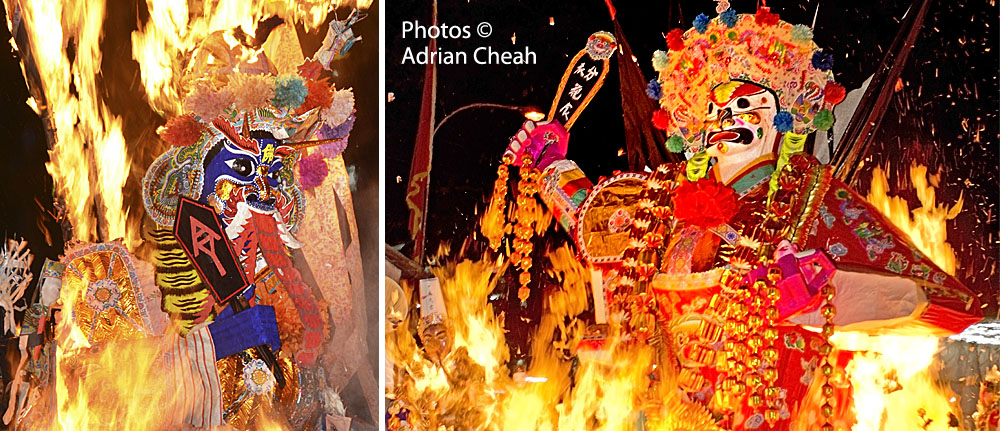
Every year, as the seventh lunar month approaches, the streets of George Town take on an otherworldly character. For a time, the city seems to belong not only to the living, but also to the "hungry ghosts" said to descend from the underworld in search of food, offerings and perhaps a little earthly attention. Known locally as Phor Thor, the Hungry Ghost Festival is far more than a single day of ritual or remembrance. Its observances unfold throughout the seventh lunar month, weaving their way through the communities of Penang and across Malaysia, and into neighbouring Singapore and Phuket, where Chinese traditions have likewise taken root. It is a season when the veil between this world and the next seems, if only for a while, remarkably thin.


According to Chinese folklore, on the first day of the seventh lunar month, the gates of the underworld are flung open, allowing its spirits to return to the earthly realm. In other words, it is something of a supernatural jailbreak! Freed to wander among the living, these spirits are believed to seek the comforts they once knew in life—food, companionship and, perhaps, a little attention from those they left behind. Some are thought to return to the homes of their descendants, making the Hungry Ghost Festival a curious kind of family reunion: one in which the guests have crossed over from the other side, and a generous spread of food might be the most gracious way to welcome them home.

It is hardly surprising, then, that so many of these wandering spirits might find their way to Penang, a place celebrated as one of the world’s great food havens. After all, who could resist a plate of char koay teow or a slice of succulent sio bak (Chinese roast pork) after an eternity in the underworld? But beneath the feasting and the festive irreverence lies something far more profound. The festival transforms Penang into a grand stage, where ritual gives expression to the enduring ties between the living and the dead, the earthly and the otherworldly, the physical and the spiritual.

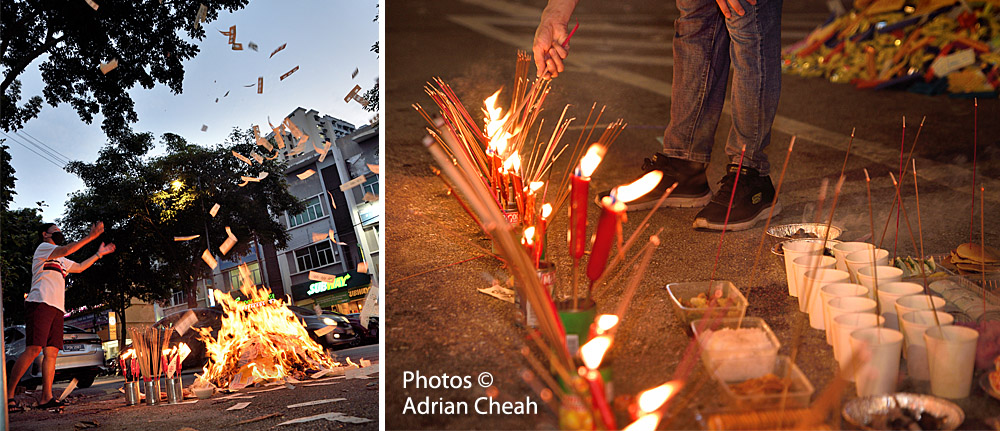
For the older generation, this tradition carries a significance far deeper than superstition. It reaches back to the roots of their forefathers, men who crossed treacherous seas to a malaria-ridden Malaya, venturing into dense jungles in search of a better life, clearing the land for tin, rubber and spices. Life was unforgiving. Many succumbed to malaria and beri-beri; others were worn down by poverty, loneliness and the harshness of an unfamiliar land. Some sought brief escape in alcohol, opium or gambling, while many knew they might never live to see the fruits of their labour.
However, amid such uncertainty, an extraordinary bond emerged. Knowing that death could come far from home and family, these men pledged to look after one another even in death—to ensure that those who died alone would not be abandoned, that they would receive a proper burial and that offerings would be made in their memory. Such bonds of fraternity were among the values that helped shape the mutual-aid traditions of the clan associations.
These forgotten dead came to be remembered as "ho sio tee" (good brothers), men who had crossed into the afterlife without descendants to mourn them. And so, centuries later, their memory continues to surface during the seventh lunar month, when offerings are placed along the streets of George Town for nameless, wandering “hungry ghosts". What may appear to the casual observer as an elaborate display of superstition is, in truth, something far more human: an act of remembrance, gratitude and honour for those who came before, whose hardships helped make possible the lives of comfort their descendants enjoy today.

But beware: these spirits have appetites that extend beyond food. Those who were denied proper burials, banished to the underworld, or forgotten by descendants who failed to honour them are believed to return in search of comfort, closure and, in some cases, even revenge. For a month, the streets of Penang become a vivid stage for this otherworldly drama. Elaborate altars groan beneath offerings of food, fruit and incense; colourful paper effigies rise above the crowds; and, as night falls, traditional Chinese opera and glove-puppet theatre, as well as modern getai performances entertain both the living and the dead.
The spirits, it is said, remember how they are treated, bestowing blessings upon those who honour them and misfortune upon those who do not. So it pays not to take chances. Keep the offerings plentiful, the incense burning and the hungry ghosts content. After all, one never quite knows who might be watching from the shadows.

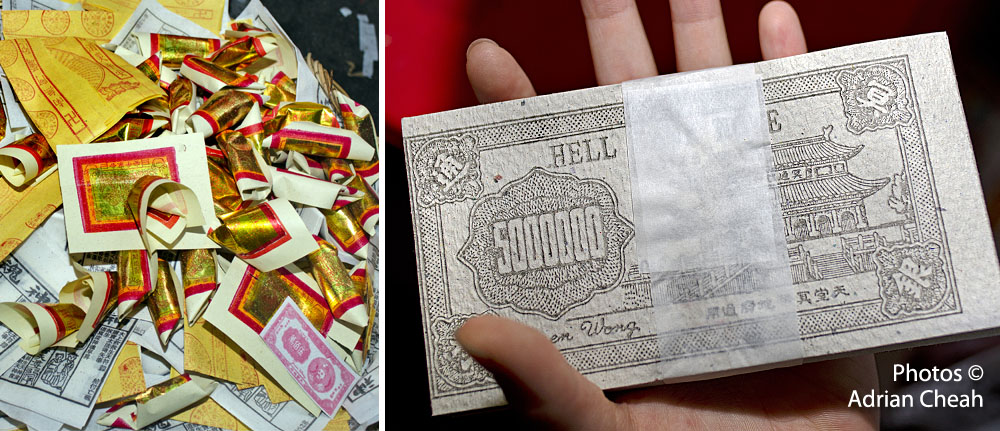
Prayers, incense, food and the burning of hell bank notes are all standard fare. Then come the paper effigies and an astonishing catalogue of worldly possessions recreated in paper and offered to the dead—houses, cars, televisions, even the latest smartphones. It is, in effect, a ghostly gift registry, tailored to whatever the afterlife might require. One can only wonder what happens when the living get creative. Imagine tossing Richard Dawkins’ "The God Delusion" into the bonfire. That would make for an interesting read on the other side!

For some families, a lavish feast is prepared especially for departed ancestors believed to be making a “return home” visit. Such offerings are also rooted in the belief that the departed must pass through the eighteen courts of the underworld, where their souls are judged and punished before being permitted to move on towards rebirth. In this sense, the Hungry Ghost Festival becomes a kind of spiritual pit stop—a final pause between one existence and the next, where a well-prepared meal might just make the journey a little easier.


Believing that generosity towards the spirits may invite good fortune, businesses and entrepreneurs often lend their support to the festivities, sponsoring Chinese street operas and puppet theatres that spring up across George Town. These performances are offered not only for the entertainment of the unseen guests, but for the living as well. And what better way to experience the festival than to settle in and watch a story or two unfold beneath the lights?
With striking, often flamboyant makeup and elaborate sequined costumes, Chinese opera performers command makeshift stages raised above the street, their voices, gestures and movements bringing intriguing tales to life against the glow of the night. But there is one curious rule for the audience: never take the first row. Those seats are not empty at all. They are reserved for the spirits.

The month of the Hungry Ghost Festival is hardly considered an auspicious time for major life events. Weddings, moving into a new home or, heaven forbid, dying are traditionally avoided. Devout believers may also put off travelling, purchasing property and closing important business deals, lest they tempt fate at a time when the spirit world is said to be at its most active. It may sound extreme, but there is a certain practical charm to it all: why rush when you have the perfect excuse to postpone everything and take things a little easier?
Children, meanwhile, are warned to stay indoors after dark, lest wandering spirits lure them away to the kingdom of the dead. Swimming is an especially emphatic no-no—hungry ghosts are said to lurk beneath the water, waiting to drag an unsuspecting swimmer under and claim a soul to replace their own. With technology and the information age reshaping how children see the world, however, some of today’s youngsters find such cautionary tales increasingly difficult to swallow. After all, it is rather hard to frighten a generation armed with Google.
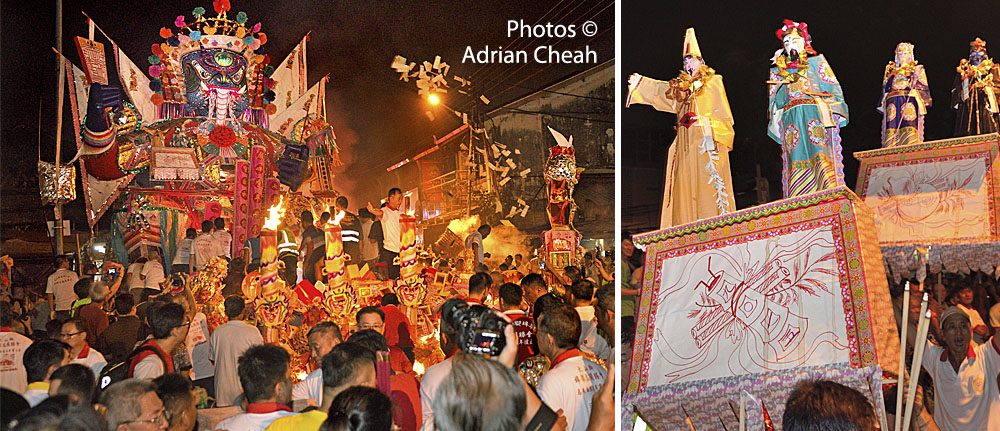

Look closely and you may notice a curious detail on the elaborate headdress of Tai Su Yeah, the King of Hell: a small image of the Goddess of Mercy, Guan Yin. According to legend, the fearsome King of Hell is, in fact, Guan Yin herself, an intriguing embodiment of both compassion and authority. During the seventh lunar month, she assumes this formidable guise to keep the restless spirits in check, a reminder that even in the underworld, mercy and severity may reside beneath the same crown.
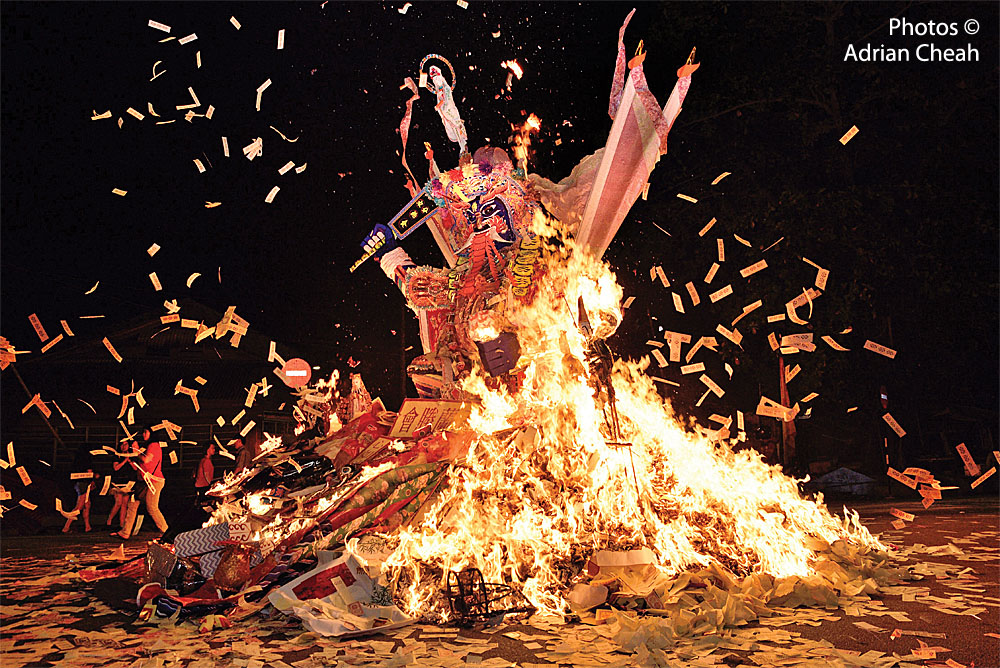
As the seventh lunar month draws to a close, the grand send-offs begin, and it is a spectacle to behold. At the stroke of midnight, the wandering spirits are said to return to the underworld, the gates closing behind them until the following year. More hell bank notes, paper deities and elaborate paper ingots are committed to the flames in a final, blazing farewell, along with Tai Su Yeah, who is given his own ceremonial send-off—a fitting tribute to the formidable guardian who has kept the restless spirits in check throughout the month.
And then, almost as suddenly as it began, the month-long encounter with the unseen comes to an end. Communities, particularly Taoist ones, can finally breathe a collective sigh of relief and return to the rhythms of everyday life, comforted by the knowledge that their obligations to the ancestors, and to those forgotten souls who have no one else to remember them, have been faithfully fulfilled.
The ghosts may have returned to the underworld, but George Town does not pause for long. Here, one celebration seamlessly gives way to another, and before the last embers of the Hungry Ghost Festival have faded, the lanterns and mooncakes of the Mid-Autumn Festival are already waiting in the wings.
---------------------------------------------------------
Written and photographed by Adrian Cheah
© All Rights Reserved
Updated 3 August 2024