"Looking After the Ashes" – unravelling the enigmatic Chinese Peranakan world of taboos and traditions
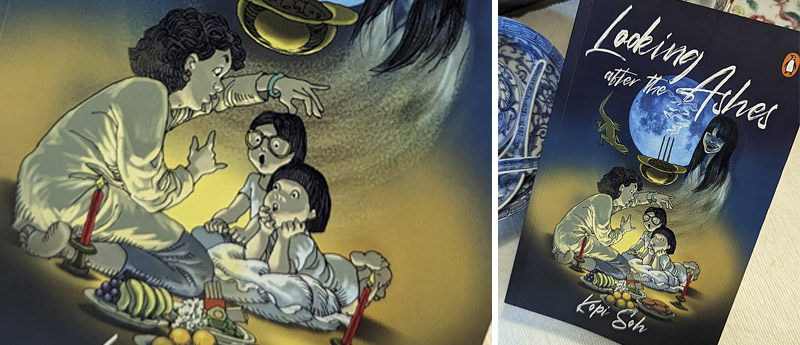
I have always stayed away from horror stories, particularly those that announce their intentions with blood and gore splashed across the cover. We are told never to judge a book by its cover. However, after more than three decades as an art director, I have always believed that a cover has a responsibility. It must set the tone, stir curiosity and, ultimately, invite the reader in.
The cover of "Looking After the Ashes" by Kopi Soh does precisely that. Two wide eyed children sit enthralled by a storyteller, their innocence set against an atmosphere that is both mysterious and faintly unsettling. There is something almost hypnotic about the image, as though the children, and the reader, are being drawn into a tale they cannot quite escape. I picked up the book expecting, at most, a curious excursion into the macabre. Instead, I found myself drawn deeper and deeper into its pages, until what began as a casual read became an unexpected page turner.

In the book, we are welcomed into the Cheah family, where the quirks, antics and lived experiences of its members unfold through the eyes of Swee Lian. She is the daughter of Jimmy Cheah Chye Huat and Ong Gim Suan, and the granddaughter of Rose Khoo Bee Choo, affectionately known as Ah Ma, and Johnny Cheah Huck Boon, or Ah Kong.
Like Swee Lian, I too was born into a Chinese Peranakan family in Penang. For me, Looking After the Ashes became more than a captivating story. It felt like a deeply personal journey into a world I knew intimately, a world coloured by elaborate superstitions, tall tales and a seemingly endless list of taboos. As the author led me through her semi autobiographical fiction, I found myself transported back to my own childhood, where tradition, folklore and family dynamics were woven so naturally into everyday life that we seldom stopped to question them.
I could almost hear the familiar cautionary tales being recounted with great gusto by the aunties of my childhood. The Nyonyas might have been soft spoken, even gentle in their manner, but when there was a lesson to be delivered, they could summon a delicious sense of drama. A raised eyebrow, a knowing look and a well timed warning were often enough to make a child think twice.

Swee Lian’s extended Taoist influenced Peranakan family is led by strong women who impart their “words of wisdom” with both love and absolute seriousness. Through her vivid storytelling, she brings to life a childhood in which the fear of evil forces, spirits and malevolent entities was never far away. Stories of the “yellow spirit”, See Loh Bun, the Pontianak, Hantu Kum Kum and even Hantu Tek Tek were part of the colourful folklore that surrounded us, particularly in the context of a multi-cultural Malaysia.
Yet in today’s technologically savvy world, a creature like Hantu Tek Tek, with her rather unfortunate pendulous breasts, would probably not stand much of a chance against Google. A curious, IT savvy child could simply look her up and dismiss the whole story as an absurd invention. But do you know what Hantu Tek Tek was supposed to do to children who ventured outside to play after dark? (Well, you do not have to be a rocket scientist to guess the answer.)
In Chapter 6, Swee Lian recounts an episode in which she reluctantly accompanied her father to an exorcism ritual. What she witnessed left her deeply shaken. Her experience resonated with me because I too once found myself accompanying my mother to an exorcism ritual, assisting my aunt who believed that she needed "help".
What I witnessed that day left me utterly dumbfounded. You cannot un-see such things!!! More importantly, such an experience can alter the way we perceive things that we do not understand or cannot readily explain. It taught me not to be too quick to make assumptions about matters that lie beyond my understanding.
Many might conclude that experiences like these, encountered during childhood, would leave lasting scars. I beg to differ. I believe that such experiences become part of the rich tapestry of childhood, adding unexpected shades to the kaleidoscope of life. We grew up learning that it was perfectly acceptable to acknowledge that there are things "out there" that we cannot explain. Perhaps that is why we learn to approach life with a certain respect, curiosity and humility.

In Chapter 7, Swee Lian witnessed the horrific and murderous act of killing "her" turtle to make turtle soup. I can very well picture what it must have been like for her! Back then, the Nyonyas took great pride in their culinary skills and believed in using the freshest ingredients for their delicious creations. This often meant stabbing the ketam batu (mud crabs) yourself, killing the lay hu (snakehead fish) yourself or standing before the frog vendor at the market to see that he/she skins the live fat ones you had chosen. On occasion in the past, my Mum would slaughter chickens herself to collect the blood for certain dishes. I would assist in plucking the feathers after scalding the bird. It is fascinating how times have changed and today, children invariably encounter neatly packaged meat at supermarket stalls, shielded from the act of killing the food that ends up on the table.

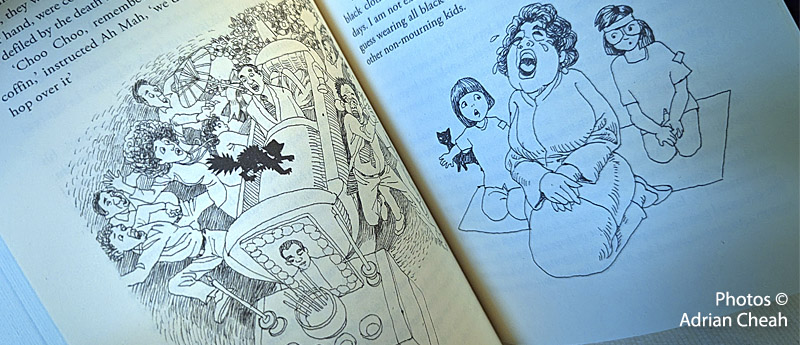
With stories such as these, the flow of the book creatively weaves the Chinese Peranakan culture in Penang, also interlacing moments from confinement to Muar Guay (baby's first full moon celebration) and from weddings to burials, completing the full circle of life. The book beckons readers to experience the rich tapestry of this unique heritage. Cherishing her roots, Kopi Soh's earnest desire to preserve her culture and traditions is well documented in this book.
The inclusion of some ink illustrations by KULit Baru adds another layer of enchantment to the storytelling.

"Looking After the Ashes" charmingly captures the essence of Chinese Peranakan culture while revealing Kopi Soh’s deep love and respect for her heritage. I could relate deeply to its personal narration, which brought back memories of my own upbringing and family ties. The wisdom, superstitions and love woven through its pages are a true treasure trove, and they have stayed with me long after I turned the final page. I sincerely hope the book leaves many others with the same profound sense of connection.
-------------------------------------

Looking After the Ashes
Author: Kopi Soh
ISBN: 9789814882101 (ISBN10: 9814882100)
216 pages, Paperback
Published 31 August 2021 by Penguin Random House SEA
Language: English
The title of the book, "Looking After the Ashes," refers to the ritual of inviting the deceased to return home to be worshipped. This practice, known as "chnia abu" in Hokkien or "inviting the ancestors," is further explored by Kopi Soh in the book. For a deeper understanding of this ritual, I encourage you to delve into its pages.
-------------------------------------
About the author

Kopi Soh is the pseudonym of a US based Malaysian author and illustrator best known for her book "Oh, I Thought I Was The Only One", published by Dawning Victory Consultancy in 2012 distributed by MPH. It is a self-help book oriented towards creating awareness of common psychological issues, which manifest themselves in daily life.
In 2013, Kopi Soh published her second book, "Oh... I Thought I Was the Only One 2", a sequel focusing on how children experience various stresses in their daily lives and teaching them skills on how to overcome them.
In 2019, her original manuscript "Looking After the Ashes" was accepted for publication by Penguin Random House SEA, and the novel was released in 2021.
Kopi Soh was also a former crisis manager with a women’s centre, training social workers and counsellors. She counsels victims in domestic violence situations and children who have been sexually assaulted. Being a crisis counsellor she was also a sexual assault team responder in the US; in her spare time she teaches social media at a community school for the elderly. Her area of specialty is in working with children, adolescents, couples, seniors, refugees, rape victims, abused kids, victims of domestic violence and families.
She founded the Facebook community "Stick It To Me" (currently called Kopi Soh’s Positive Healing Doodles), a page centred around producing "healing art" for the terminally sick and needy, and organises a group of volunteers to produce art for hospitals and charities. Her work with "Stick It To Me" was recognised in the Digi WWWOW Awards 2015, winning an award in the Social Gathering category. She also served as the official illustrator for TEDxWeldQuay 2013.
Kopi Soh is currently pursuing her doctoral degree. Her research focuses on Online Social Support, Social Networking Sites usage and Flourishing in Older Malaysian Women.
-------------------------------------
Written and photographed by Adrian Cheah
© All rights reserved
30 July 2023