Church of the Assumption, among Penang's historical landmarks

George Town, the vibrant heart of Penang, is home to one of the most diverse religious communities in Malaysia. Here, places of worship belonging to different faiths stand side by side, each with its own distinctive architecture and history, serving generations of believers.

Discovering these places of worship is made all the more rewarding by joining a guided heritage trail through George Town, particularly one that traverses the Street of Harmony. It offers a fascinating glimpse into the island’s religious diversity, with places of worship representing different faiths situated remarkably close to one another. While the trail typically highlights Masjid Kapitan Keling, Sri Mahamariamman Temple, the Goddess of Mercy Temple and St George’s Church, it is well worth extending your journey to include the Church of the Assumption.
A glimpse into the history of the church
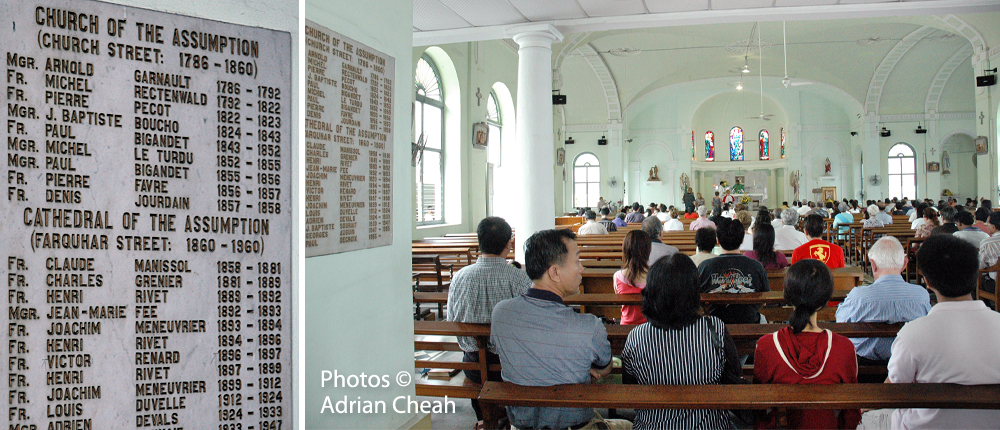
Upon entering the Church of the Assumption, a plaque on the left wall records the names of the priests who have served the parish since its earliest days. The first name on the list is Monsignor Arnold Garnault, who ministered here from 1786 to 1792. In 1786, the first Catholic community in northern Malaya, originally based in Kuala Kedah, arrived in Penang on the eve of the Feast of the Assumption. Together with Bishop Garnault, they built a modest wooden church on Church Street and named it the Church of the Assumption. Garnault’s presbytery stood on an adjacent street, which later came to be known as Bishop Street.
In 1802, the wooden structure was replaced by a brick church with a tower, which served the Catholic community until 1857 under the stewardship of Father Denis Jourdain, the last priest to serve at that location.
The church was then relocated to Farquhar Street, where the present structure was built in 1860 under the direction of Father Claude Manissol. By October the following year, the newly completed church, with seating for approximately 1,200 worshippers, hosted its first Mass. Father Manissol remains interred within the church, his grave marked by an inscribed marble slab set into the floor.

The church underwent significant renovations in 1928, when two wings were added to the structure. In 1955, the Diocese of Penang was established by papal decree, with the Church of the Assumption designated as its cathedral and episcopal see. The sanctuary was subsequently renovated to accommodate the cathedra, or bishop’s seat, of Penang’s first bishop, the Right Reverend Monsignor Francis Chan.
In 2003, the cathedral seat was transferred from the Church of the Assumption to the Cathedral of the Holy Spirit, bringing an end to its 48-year tenure as Penang’s cathedral.

On 15 August 2016, the Church of the Assumption closed its doors for a 14-month restoration project costing RM2.5 million. The extensive work was completed in time for the rededication of the church on 1 January 2018.
A union of love
My parents were married at the Church of the Assumption on the morning of 27 December 1952. It was within these sacred walls that they pledged their love with the timeless vows: “... to have and to hold from this day forward, for better, for worse, for richer, for poorer, in sickness and in health, until death do us part ...” The ceremony was solemnised by the French priest, Father Georges Auguin. It must have been a beautiful Mass, with heavenly hymns rising from the choir and filling the church beneath the soaring pipes of its grand organ. Sweet, demure-looking Mum was only 18 then, while dashing young Dad was 26.

Left photo: Wedding witnesses Lim Soon Huat and Doris Wong with the bridal couple.
The wedding celebrations continued with a lunch reception at the grand Shanghai Hotel on Gurney Drive, followed by a dinner at a restaurant in New World Park. Dad was a young, thriving businessman then and, according to Mum, the venue was filled to the brim with his business associates and their families, feasting and having a ball.
The Church of the Assumption has always held a special place in my parents’ hearts, perhaps because it was here that they embarked on their adventurous journey through life together. Today, Mum looks back on the 54 precious years they shared, nurturing and loving eight children, 20 grandchildren and 11 great-grandchildren. This year marks what would have been their 74th wedding anniversary. Though she misses Dad dearly, Mum chooses instead to treasure the blessings of the life they shared.
The church today


Situated at the corner of Farquhar Street and Love Lane, this stately grey building is watched over by a pair of life-size white marble angels, each holding a shell filled with holy water. Serene and graceful, they greet visitors as they enter the church.

These two rows of chairs at the entrance of the Church must have an intriguing tale to tell. At the end of each armrest is the miniature head of a bald man.
The interior is enhanced by beautiful stained-glass panels, life-size statues of saints and the Blessed Virgin Mary, Stations of the Cross wall hangings, and an authentic pipe organ. The church continues to serve Penang’s Catholic community, with Masses celebrated on Saturdays and Sundays.

Directly in front of the church, beyond the porch, stands a dome-shaped grotto. Flanking the statue of Our Lady are two stained-glass panels that I designed. They were generously donated by Jennifer Khaw.
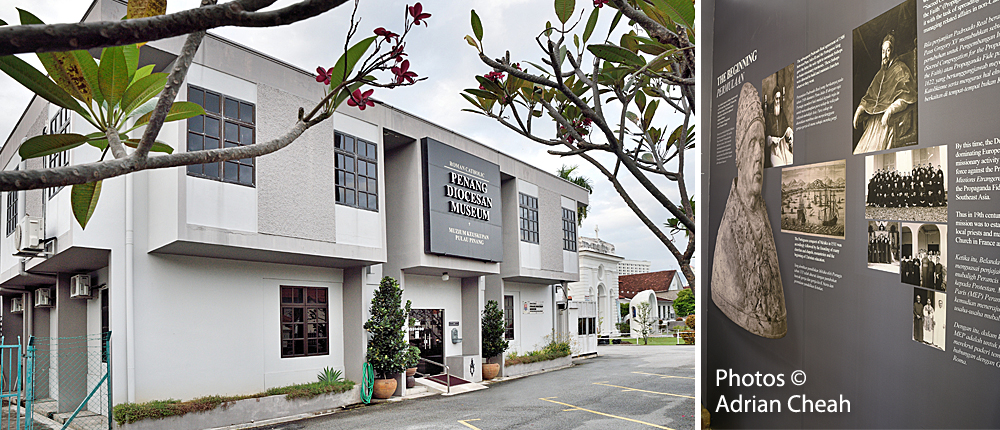

The church grounds also house the Roman Catholic Penang Diocesan Museum, which traces the history of the Church’s missionary activities through a fascinating collection of artefacts and memorabilia. There is also an art gallery showcasing paintings by Father Joseph Reutens.
The one-of-its-kind pipe organ

Located on the first floor of the church is a grand pipe organ, built in England in 1914 and installed at the Church of the Assumption in 1916. Commissioned by Father Louis Duvelle, the parish priest at the time, the magnificent instrument is one of Malaysia’s oldest surviving pipe organs and remains in working condition to this day.
Built by the firm of Morton & Moody of Oakham, England, the organ did not arrive in Penang until two years later. The delay was due to the difficulties of shipping the instrument during the First World War.
Let us take a closer look at this remarkable instrument. Constructed from oak, pine and mahogany, it has 640 pipes made of lead and zinc. The organ produces sound by forcing pressurised air, known as wind, through a series of pipes. When a key is depressed on the keyboard, wind passes through one or more pipes from a chest beneath them. Unlike other keyboard instruments such as the piano, whose sound begins to fade the moment a key is struck, an organ can sustain a note for as long as the key is held down, thanks to its continuous supply of wind.
Over the years, ongoing maintenance and restoration have ensured that this magnificent instrument continues to serve the congregation faithfully. In the hands of a skilled organist, it can bring both sacred and secular music to life. Accompanied by the voices of a good choir, its uplifting melodies rise through the church, particularly during Christmas vigils and celebratory Masses, filling the sacred space with a sound that has endured for more than a century.
What is the feast of the Assumption?
According to Roman Catholic doctrine and tradition, the Blessed Virgin Mary, “... having completed the course of her earthly life, was assumed body and soul into heavenly glory.” The feast commemorating Mary’s passage into Heaven is known as the Solemnity of the Assumption of the Blessed Virgin Mary and is observed by Roman Catholics.
This doctrine was dogmatically and infallibly defined by Pope Pius XII on 1 November 1950 in his Apostolic Constitution Munificentissimus Deus. In denominations that observe the feast, the Assumption is commemorated annually on 15 August.

Here are masterpieces painted by two highly influential artists of their times on the Assumption of Mary.
Left: Frari Assumption (The Assumption of the Virgin), Titian, 1515–1518; this painting is on the high altar of the Basilica di Santa Maria Gloriosa dei Frari in Venice.
Right: The Assumption of Mary, Rubens, 1626; this altarpiece is in the Cathedral of Our Lady in Antwerp, Belgium.
For me, the Church of the Assumption is more than a historic landmark. Within its walls, my parents began their life together, and more than seven decades later, their story remains part of the long history of this remarkable church.
------------------------------------
Church of the Assumption (Penang)
3 Lebuh Farquhar, 10200 Penang
Tel: +604 261 0088
------------------------------------
Written and photographed by Adrian Cheah
© All Rights Reserved
22 November 2021 (updated 15 August 2026)