Stitching Through Hardship: A Nyonya's War-Time Chronicle

At the Church of the Assumption, nestled amidst the bustling streets of George Town, the hearts of Louis Michael Martin and Emily Elizabeth Surin became forever entwined. Their love story found its new beginning on 7 August 1926, when Rev. Fr. P. Lerond officiated their marriage. The church would have looked somewhat different then from the one we see today, as it underwent a major renovation in 1928, when two wings were added.

Emily’s baptism records which was written in Latin shows that she was adopted and baptised at the age of one year and three months. Additionally, it is worth noting that her name was listed as “Emilia” in the document. Photo © Vincent Boudville
Louis, 46, with his French lineage, and Emily, 30, an orphan who had blossomed under the care of the Light Street Convent across from the church, came from vastly different worlds. Yet faith, circumstance and perhaps a little fate brought their paths together. The Mother Superior of the convent gave her approval and bestowed her blessing upon the couple.
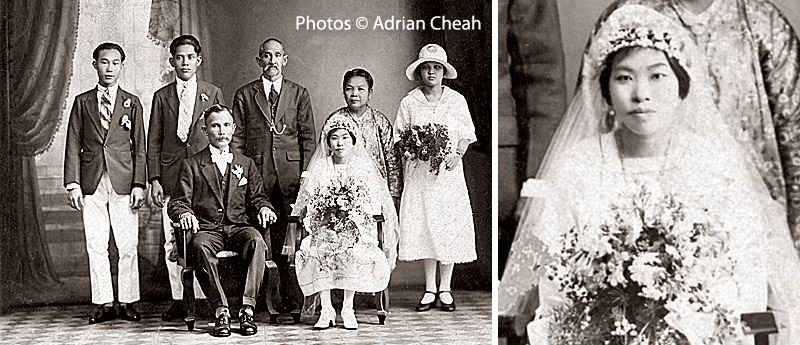
7 August 1926: Seated are Louis Michael Martin and Emily Surin. Marianne (in the white hat) is the groom’s niece. Second from left is Marianne’s husband, Edward. Next to him are his parents, Frederick and Adelaide Boudville.
Louis, 46, with his French lineage, and Emily, 30, an orphan who had blossomed under the care of the Light Street Convent across from the church, came from vastly different worlds. Yet faith and circumstance brought their paths together. The Mother Superior of the convent gave her approval for the marriage and bestowed her blessing upon the couple.
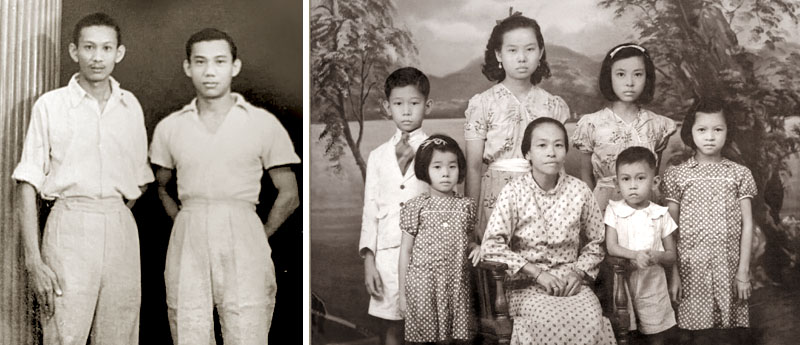
Left photo: Charles (left) and Fred.
Right photo: This family photo must have been taken a few years before WWII. Standing behind from left: Giles, Mary and Margaret. Front row from left: Patricia, Emily, Louis Jr. and Marjorie. Photos © Esther MacFarlaine
They first adopted two sons, Fred and Charles, before welcoming six children of their own—Mary, Margaret, Giles, Marjorie, Patricia, my Mum, and Louis Jr. These children became the very heartbeat of Emily’s life and the reason she would somehow find the strength to keep her family afloat through the tempestuous years of war.
Fifteen years after they exchanged their vows, pledging to stand together “... till death do us part”, tragedy struck. On 2 March 1941, Louis Sr., aged 61, died of what was recorded as “heart trouble”. His passing cast a long shadow over the family. Emily, still only 45, was suddenly left to raise eight children and provide for them without her husband.

The circumstances surrounding his death remained shrouded in mystery and heartache. Mum, their youngest daughter, holds in her heart the belief that her father’s passing had been influenced by an unsettling dark magic charm, cast upon him by their neighbour, a Malay bomoh. The day of his demise also witnessed the inexplicable death of his beloved tekukur (spotted dove), a haunting coincidence that only deepened the family’s sense of loss. However, the origins of these tragedies would remain forever obscure.
Many years later, Mum recalled another curious turn of events. As the bomoh grew old, she noticed that none of his children, despite or because being educated in esteemed schools such as St. Xavier’s Institution, showed no interest in inheriting the mantle of the dark arts and instead, chose different paths. "Shortly after the bomoh took his last breath, the very spirits that he had harnessed to do his bidding exacted a cruel toll, claiming the lives of all his children", Mum recounted with a shudder.
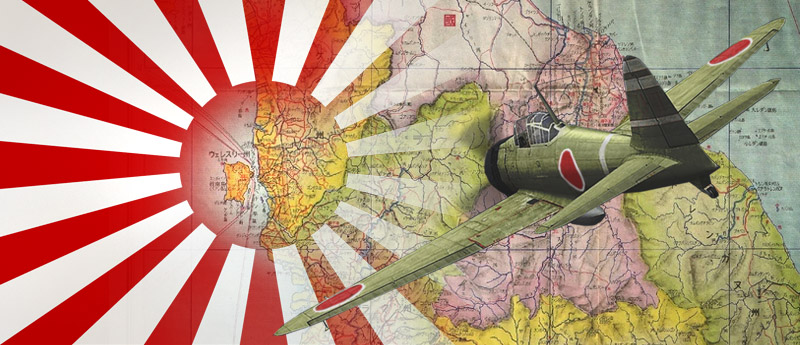
As World War II began to tighten its devastating grip in the horrifying year of 1941, Louis Sr.’s passing left his beloved family navigating turbulent waters without their steadfast captain. The world, already trembling with the dark forebodings of war, grew even more tumultuous.
Fred and Charles, who were much older, though their exact ages remain uncertain, were joined by Mary (14), Margaret (13), Giles (11), Marjorie (9), Mum (7) and little Louis Jr. (6). Together, they found themselves adrift in a world overshadowed by uncertainty. With the war came the relentless grip of hunger and fear, agonising companions that never seemed to leave their side.

In the probated estate, it is recorded that Louis Martin Sr. provided a $400 loan to Ong Ho Tat for “payment of doctors’ bills, medicines, and other expenses incurred during his illness”. However, following Ong’s passing on 3 June 1922, it was decided that all his land would be transferred to Louis as a form of debt repayment. Photos © Vincent Boudville
In December 1941, the tumult of World War II erupted, and the family found themselves caught in the merciless tides of history as the Japanese invasion of Malaya began. Until then, Emily had been a homemaker all her life. She had never needed to be the family’s breadwinner. Now she had no choice. She sold their cherished family home at Aboo Sittee Lane and moved to a smaller house at 253E in Kampung Sireh, located around Lengkok Burma, Codrington Avenue and Burma Road. The large parcels of land her late husband had acquired along Peel Avenue, where Island Hospital now stands, were also sold to ensure their survival.
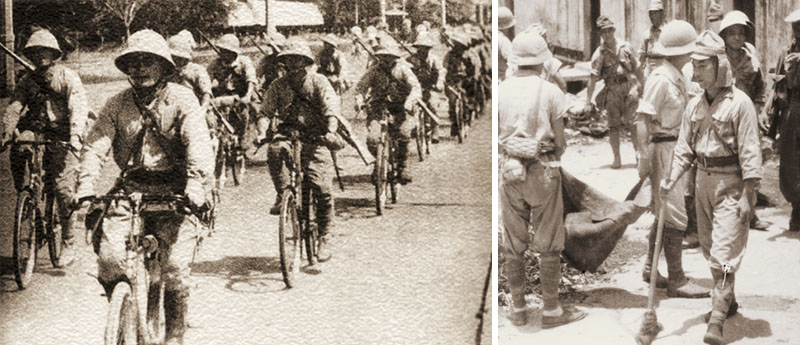
In the wee hours of the morning of 9 December, air-raid sirens wailed, a haunting prelude to the impending tragedy. Eight Japanese planes machine-gunned the small airstrip at Bayan Lepas, damaging the runway. On the afternoon of 10 December, a one-sided dogfight unfolded over Mata Kuching aerodrome, with 26 planes taking part in the raid and no more than half a dozen RAF fighters rising to engage them. Within two days, the Japanese had overwhelmed the Royal Air Force and Royal Australian Air Force, securing total aerial supremacy. Emily also learned that the Butterworth airbase and nearby oil tanks had been set ablaze.
On 11 December, bombs were dropped on densely populated parts of Chinatown in Penang. The bombs that rained down included heavy demolition, light anti-personnel and incendiary devices, each one a harbinger of death. As recounted by the editor of The Straits Echo, Manicasothy Saravanamuttu, this relentless assault bore a grim toll, reducing “some 500 buildings were destroyed in George Town and 150 bodies were rotting on the streets”.
The British, infamously, looked after themselves first. By 14 December, most European women and children had evacuated, and by 16 December, almost the entire European civilian population had abruptly departed without warning.
For Emily, there was no escape. Her children were here, and she would stay with them. The fear that enveloped her was like a thunderbolt, overwhelming her with the devastating reality. So much had already been lost that year, and the spectre of further loss loomed ominously. In those dark days, Emily’s heart turned to prayer, a fervent plea to keep her eight children safe. “Tuan Allah, please protect them all”, she implored, as she bargained with the divine for the safety of her family.

Vintage kebayas with intricate embroidery, reminiscent of the exquisite embellishments that Emily would have been familiar with.
Amidst the wartime chaos, Emily’s indomitable spirit, though brutally shaken, burned even brighter. The orphan who had once learned to sew in the hushed corridors of the convent now harnessed that skill to make ends meet, however meagre the earnings. Through needle and thread, she found a way to survive and put food on the table.
As her grandson penning this story, one of my deepest regrets is that I never had the chance to own one of her beautiful kebayas, embroidered with intricate floral motifs, , to keep as a cherished memento. Mum often spoke of their exquisite beauty, each one a reflection of Emily’s patience, ingenuity and the love she poured into every stitch.

As I listened to Mum’s stories, I found myself thinking of Studio Ghibli’s Grave of the Fireflies. Its portrayal of children enduring hunger, fear and the unimaginable hardships of war was both beautifully crafted and deeply disturbing. I remember the heartbreaking scene of Setsuko making little rice balls from mud because she was so hungry. Both stories remind us that, in the reality of war, childhood innocence is most brutally ripped apart, leaving scars that time alone cannot heal. I cannot begin to imagine what Mum must have gone through at just seven years old.

For the Martins, daily life was marked by frugality and scarcity. Emily cooked rice when possible, but often the family survived on diluted porridge or porridge with kacang hijau (mung beans). They grew their own vegetables and fruits: sweet potatoes, brinjal, long beans, winged beans, kangkung, bayam, murungai (drumsticks), jambu, papaya, bananas, coconut and chillies. Mum noted that they often ate the vegetables they grew as raw ulam with sambal. Nature’s bounty, however, did not yield its treasures overnight. Sweet potatoes, for instance, took three to four months to mature. Meat was a rarity, although they raised their own chickens and ducks. The gnawing hunger became a constant companion.

Margaret, barely into her teenage years, left the innocence of childhood behind to work as a waitress. She did what she could to help her family survive. At such a young age, she understood what was needed. Once, a kind-hearted Japanese soldier who took a liking to her gave her a huge gunny sack of rice. For a family living from one meal to the next, it was a lifeline.

The war brought fear into every corner of George Town. Japanese soldiers were everywhere, their presence a grim reminder of the occupation. The family kept their interactions with them to a minimum whenever possible, for their own safety, a necessary precaution to avoid trouble and stay alive.
One harrowing day during curfew, Emily returned home from the market to a chilling sight. Japanese soldiers, invaders of her home, were ransacking everything. Amid the disorder, one soldier callously hurled a wooden chair in her direction, a perilous act of aggression. With God looking out for her, the chair fell short, sparing her petite frame, barely reaching five feet in height, from a fatal fate. With fear pulsing through her veins, she fled the perilous scene as swiftly as her nimble feet could carry her. The soldiers, it seemed, must have been searching for ammunition, firearms or anything else they deemed valuable for their war effort. Thankfully, this terrifying intrusion proved to be a single event during the war.
Many households dug air-raid shelters as they braced themselves for the threat of further bombings. These were years haunted by memories of beheadings, as the Japanese military resorted to brutal measures to maintain control. When the world around them was filled with fear and uncertainty, their faith and prayers became an anchor, keeping them grounded and giving them hope.
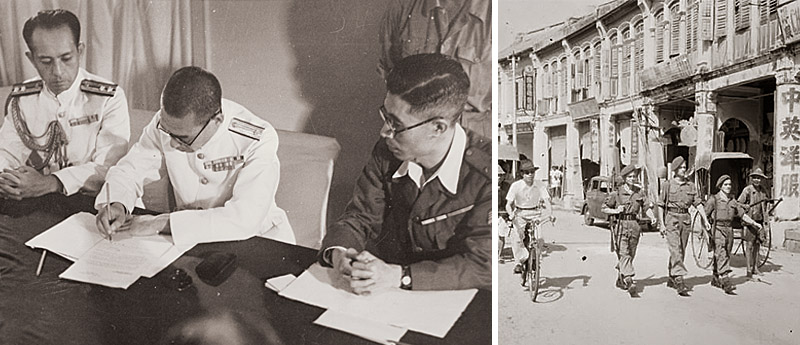
Left photo: 4 September 1945: Admiral Bazudi, commander of Japanese forces, Penang, signs the surrender document watched by the Japanese Lieutenant Governor of Penang (right) and the admiral’s chief of staff, Captain Hidaka. Photo: Public Domain.
Right photo: September 1945: Three members of the RAF Regt on foot petrol in George Town, Penang. Photo © Imperial War Museums

September 1945: British forces drives through Penang after the Japanese surrender. Photo: Public Domain.
This story is a testament to the strength and resilience of a family bound by adversity. Emily embodied the quintessential Nyonya qualities of frugality, resourcefulness and ingenuity, transforming what little she had into a means of survival. These treasured qualities live on in the hearts of her family to this day, carried forward by Mum and, hopefully, by me as well.
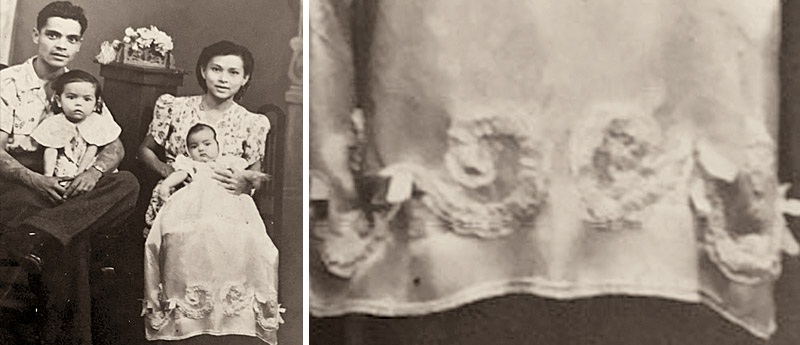
Baby Yolanda with her parents Margaret and Mac, and her sister Esther. The beautiful christening gown was sewn by Emily. Photo © Yolanda MacFarlaine

Emily and her grandson, Adrian Cheah, with Emily donning a kebaya paired with a batik sarong. Her hair elegantly coiled in a bun. Emily lived a full life, reaching the age of 84.
Written by Adrian Cheah, grandson of Emily Elizabeth Surin
© All right reserved
9 November 2023