Galle Fort—Sri Lanka's Most Glorious World Heritage Site

I visited Galle Fort twice, once in 2011 and another in 2015. Built by the Dutch in the 17th century, the 130-acre fort is one of Sri Lanka’s most prominent UNESCO World Heritage Sites. Located at the bay of Galle on the southwestern coast of the island, it has retained its charm and beauty even after going through dramatic changes in history—invasions, battles, colonisations, terrorist attacks, plagues and even a tsunami.
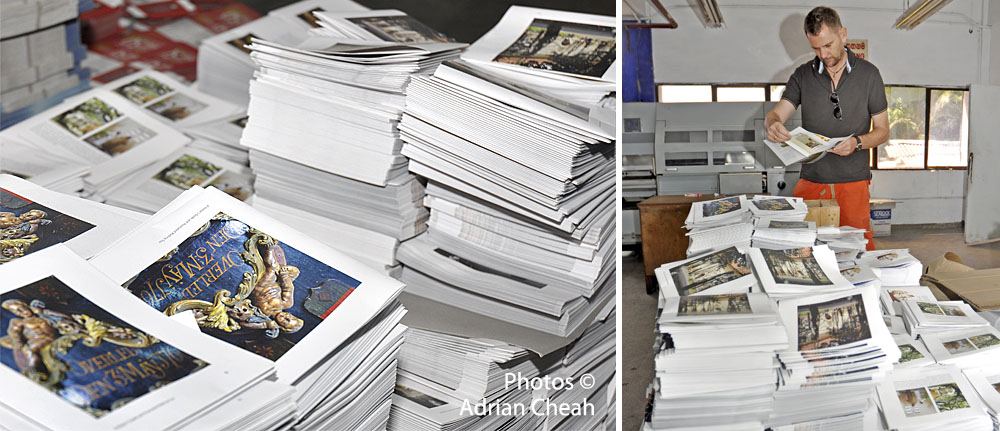
In 2011, I had the opportunity to design a book on Galle Fort entitled “Galle Fort, World Heritage Site – A Visitor’s Guide and Illustrated Walking Tour". It was written by Mark Thompson and Karl Steinberg, with Karl also providing all the photography. Thanks to modern technology, we coordinated everything online—I was in Penang, while Mark and Karl were based in Galle Fort.
After months of work, we dotted the i’s and crossed the t’s, refining every detail until we had a beautifully designed book that was both informative and engaging. The final artwork was sent to Sri Lanka for printing. Karl suggested that I travel to Sri Lanka to oversee the printing process in Colombo and also explore Galle Fort in person.

Aitken Spence Printing & Packaging in Colombo was highly professional. Its quality printing made the vivid photographs leap off the pages and capture attention. The three of us were thrilled with the result. Flipping through the finished book for the first time was deeply satisfying, knowing how much effort had gone into bringing it to life.

Delighted with our work, we then headed to Galle Fort. When I first began designing the book, I never imagined I would eventually have the opportunity to explore the fort firsthand—walking through its historic streets and meeting its people. You never quite know where life will take you, and it helps to be ready when opportunity comes knocking.


At Galle Fort, I stayed at the award-winning heritage boutique Galle Fort Hotel and was given The Grand Apartment, its most impressive suite. The majestic proportions of the suite came complete with its own private veranda, living room, dining area, grand bedroom as well as a spacious bathroom. Nothing was left to chance and everything in the suite had been carefully curated. The fifteen-foot ceiling high suite, with classic shuttered windows and rich teak floorboards, was furnished with antique furniture, vintage carpets, comfortable chaise lounges as well as an enormous Dutch spiral four poster bed. It even had a vintage brass telescope in perfect working condition!
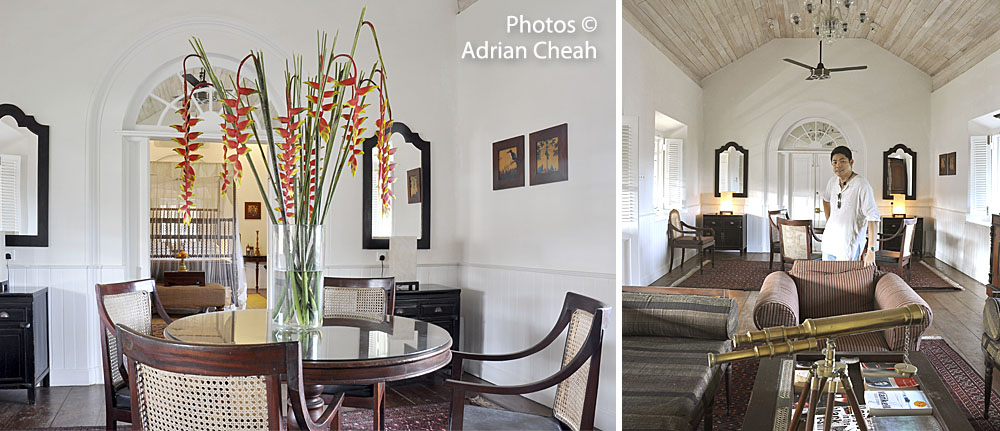

Having stayed in such a luxurious suite, it is hard to imagine that the building at 28 Church Street once fell into complete disrepair. In 2003, Karl and Christopher Ong acquired the property and spent two years meticulously restoring it to its former glory.
Halfway through the restoration, the devastating Boxing Day tsunami of 2004 struck. Galle Fort itself, protected by its sturdy ramparts, largely survived. The hotel became a refuge for local and foreign survivors as well as a coordination centre for UN teams assisting with reconstruction of roads and bridges.
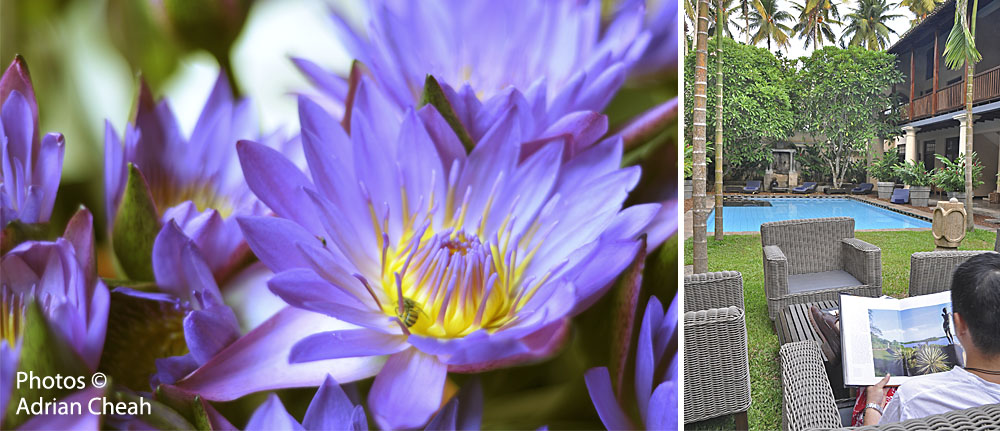
In 2005, Galle Fort Hotel opened its doors to the public. Since then, it has received outstanding reviews from guests worldwide. In 2007, it was awarded the UNESCO Award of Distinction for Heritage Conservation, a fitting recognition of its careful restoration.
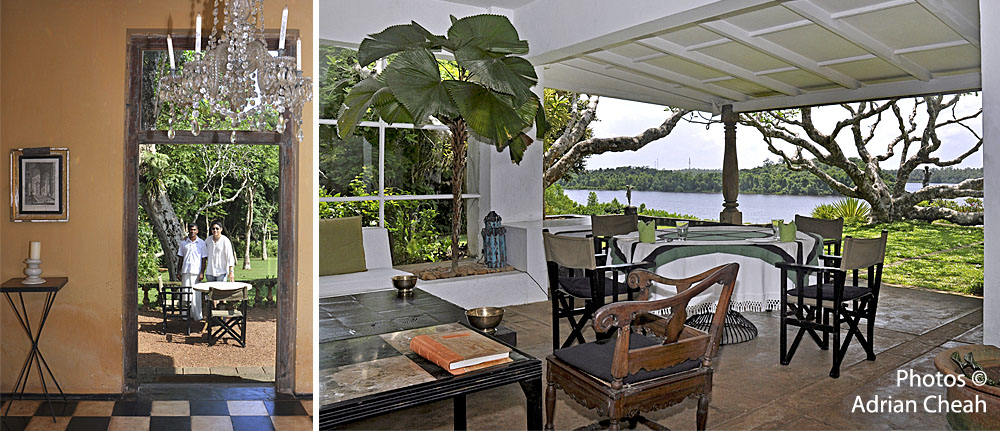
In the hospitality industry, the personal and human experience is paramount in creating a warm, memorable stay. The charismatic general manager, Ewan Taylor, made me feel very welcome. He kindly arranged an experienced masseur for a therapeutic full-body massage, as well as a tea plantation tour for Mark and me, where we met owner Anura Gunasekera, who signed a copy of his book The Suicide Club. There was also a luncheon at Lunuganga Country Estate, the home of the acclaimed Sri Lankan architect Geoffrey Bawa, attended by Karl and me.
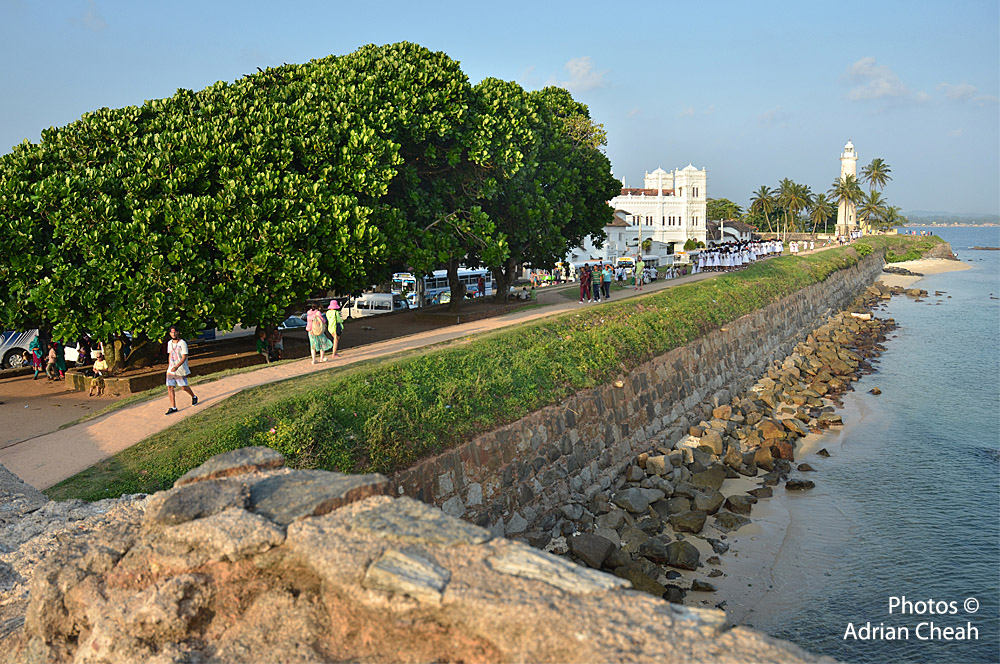
Now, allow me to take you on a brief tour of the fort.
Let us begin at the harbour, near the jetty outside the Old Gate. Two thousand years ago, this area was home to simple Sinhalese fishing villages. Seven hundred years later, everything changed with the arrival of foreign seafarers. The Portuguese, led by Lorenzo de Almeida, first landed in Ceylon, now Sri Lanka, in 1505. By 1524, they had begun building Galle’s first fort, initiating over four centuries of colonial influence.

The Portuguese colonists made a grave mistake by underestimating the threat of seaborne invasions, thereby losing control of the Fort to the Dutch. Learning from this, the Dutch heavily fortified it against both land and sea attacks. The ramparts were built approximately twenty metres high and seventeen metres thick, extending over a three-kilometre perimeter and enclosing 130 acres. Constructed from solid coral rock, with earth and ballast packed between double walls, the fort was designed as an impenetrable defence system, punctuated by fourteen bastions, an extraordinary feat of engineering that has endured for centuries.

To the southeast of the jetty, facing Galle Town, is the round-shaped Black Fort (formerly known as Forta Leza) built by the Portuguese in the 1580s. There were once eight cannons mounted on this bastion.
Above the arched entryway of the Old Gate is the British Coat-of-Arms which replaced the original Dutch insignia in 1796. On the reverse side of the entrance, the original Dutch VOC (Vereenigde Oost-Indische Compagnie) Coat-of-Arms can be found. Fuelled by the lucrative seventeenth-century trade, the Dutch warehouse running almost the entire length of Queen Street was once the most important building in the Fort. It was used to amass an emporium of the VOC's treasures – spices, silk, porcelain and ivory – before they were shipped to Europe.
Opposite the warehouses lies Court Square, the historic centre of Galle’s legal system. Nearby, Akersloot Bastion marks the start of Hospital Street. The first hospital here was founded by Portuguese Franciscan friars. It later witnessed the devastating smallpox epidemic of 1786, which claimed over 800 lives in Galle. It also endured bubonic plague outbreaks in 1922 and 1929.


The far end of Hospital Street offers views eastward beyond the port to the Rumassala heartland. The huge white "Peace Pagoda" was initiated by Nichidatsu Fujii, a Japanese Buddhist monk who believed in non-violence.
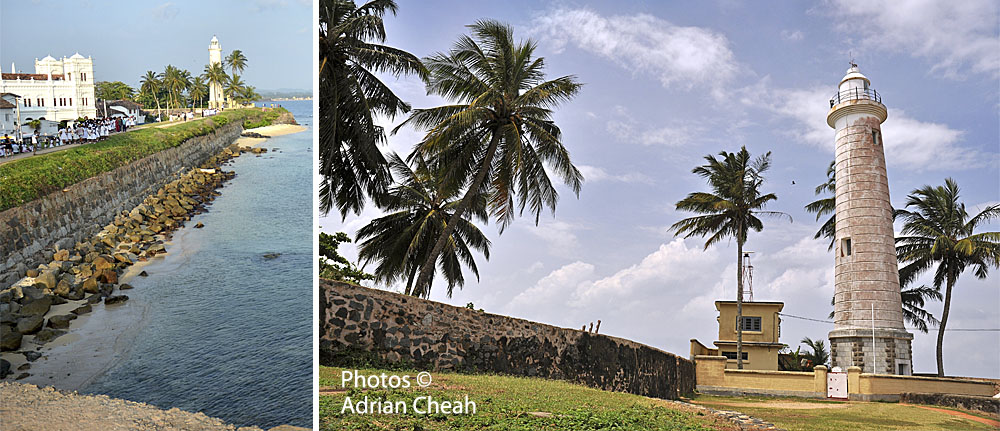
At the southern end of Lighthouse Street, in Utrecht Bastion, is Galle's second lighthouse. The first one, arriving from Scotland in 1848, was erected on a small bastion to the west, known as Flag Rock. It was, however, razed to the ground and replaced by the second lighthouse in 1938. Until today, the lighthouse guides ships into Galle's harbour.

A stone's throw away from the lighthouse is the white Meera Jumma mosque, the second mosque built in the Fort at the corner of Leyn Baan Street. This mosque is frequented by over half of the population (Muslims) from the Fort.


Nearby, the Flat Rock Bastion, enables you to browse the wares of peddlers or watch free-style divers plunge perilously into the sea below. Here, the old Dutch VOC flag flew high. Enjoy spectacular vistas of the Laccadive Sea as well as the crashing waves as they hit the rocky shoreline.

From the bastion, walk along Rampart Street before turning right into Parawa Street. At the end of Parawa Street, turn left to Sudharmalaya Temple.
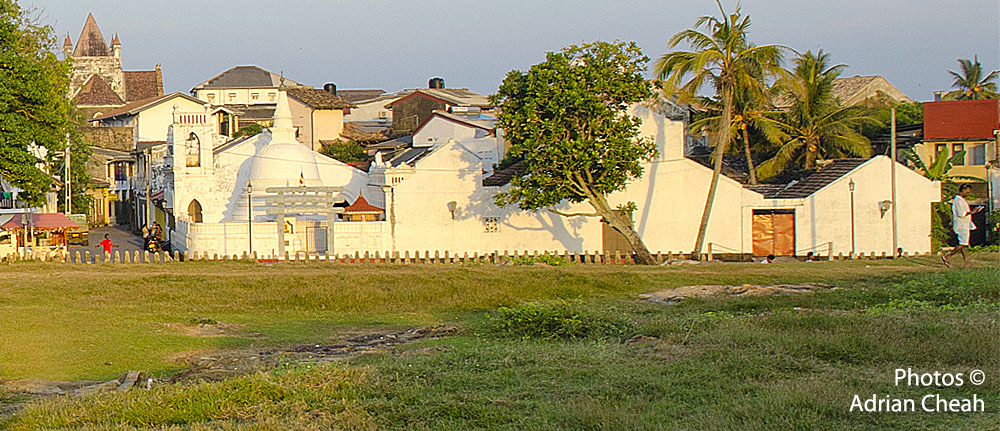
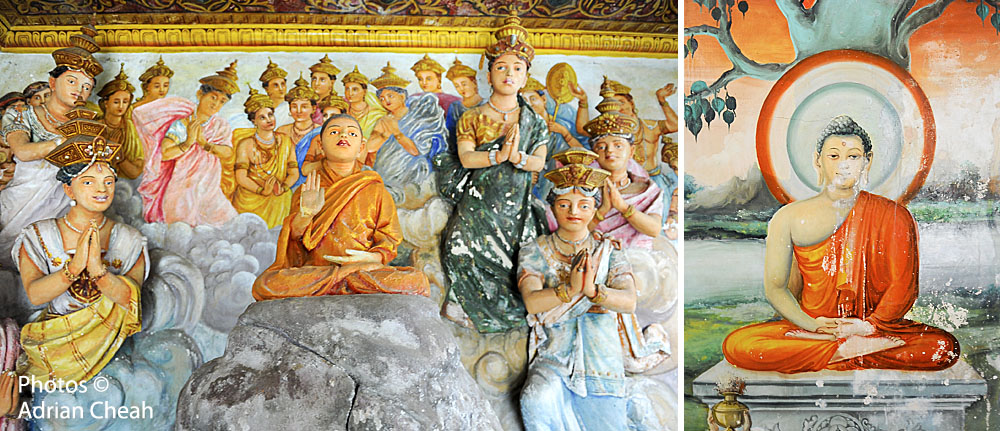
Sudharmalaya Temple has a white stupa symbolising the enlightened mind. The shrine room houses a large reclining Buddha as well as frescoes depicting stories of his life. Two other smaller rooms containing images of Hindu deities, hidden behind large curtains. The blend of Buddhist and Hindu iconographies is quite common in Sri Lanka.

From the temple, walk up the ramparts passing three bastions – Neptune, Clipperberg and Aeolus – before reaching the Star Bastion. Its solid, impassable walls once double up as a site of the former Dutch prison.


One of the Fort's most striking features is the Clock Tower, which stands sentry over the Moon Bastion to the north of the citadel since 1882. The clock tower was built in recognition of the services of renowned burgher Dr. Peter Antonisz, who aided the inhabitants of the Fort when the bubonic plague struck.

The Main Gate is located between the Sun and Moon bastions.

In 1620, the Portuguese built the sturdy Sao Iago Bastion, which was renamed by the Dutch as the Zon (Sun) Bastion in 1667. Thirty years later, the base of the bastion was further strengthened. The Sun Bastion offers some of the best views of Galle International Cricket Stadium. Walk down Church Street and you will pass the Galle National Museum before reaching Amangalla.


At the time that the Oriental Hotel was opened in 1863, Victorian Galle was a vibrant city at the peak of its glory. Today, it is run under the Aman Resort Group as the exclusive Amangalla. On my second visit to Galle Fort in 2015, Karl, Darian Jotikasthira and I had a scrumptious dinner at Amangalla.

The next building after the Amangalla is the Dutch Reformed Church. Completed in 1755, the church, with typical gables, a high vaulted ceiling and large arched windows, is a landmark building in the Fort. The church still maintained its original calamander wood pulpit, a vintage grand organ, beautiful stained glass panels and honeycombed floor tiles. Part of the floor is also paved with gravestone slabs of the Dutch elite.

Across the road from the post office and the Bell Tower is the former Dutch Governor's House, built in 1683 by Thomas van Rhee. When the British came into power, the building was renamed King's House and then Queen's House when their Governor took residence in 1796. In the late 1800s, the British built a new harbour in Colombo and Galle fell into decline. They sold Queen's House for £15,000.

Continue your journey straight and you will pass the All Saints' Church and Clan House before reaching Galle Fort Hotel, located right at the heart of the Fort.
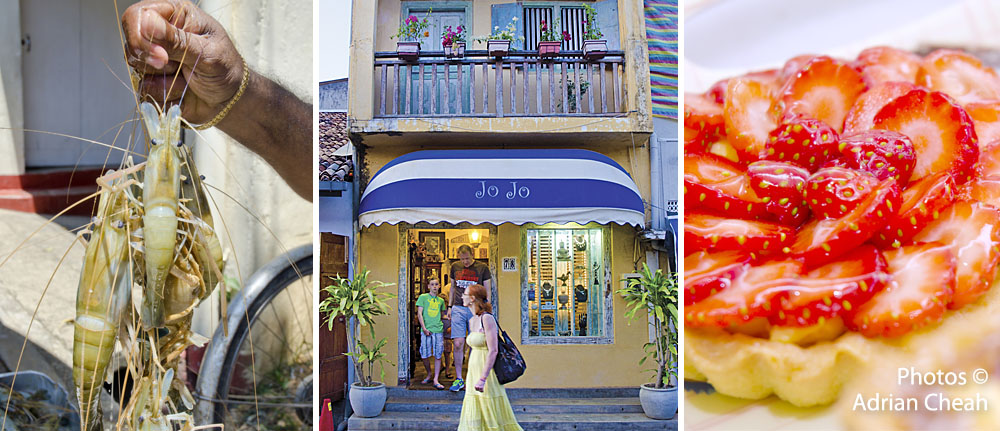
Thank you for embarking on this virtual tour which would have covered most of the interesting sites at the Fort. However, the experience of savouring mouth-watering cuisine, enjoying cool sea breezes caressing your face, being pampered with rejuvenating massages, falling for glittering gems and creative handmade crafts, can only take place at the Fort. Like the school children below, get off the ramparts when you are there and soak your feet in the ocean. It will make the experience more poignant.


If you like to know more about Galle Fort and its fascinating tales, get a copy of the book available at most bookshops at the Fort. Never forget that in 1988, UNESCO declared Galle Fort as a World Heritage Site.

---------------------------------------------------------
Written and photographed by Adrian Cheah © All rights reserved
22 May 2011

PS: Many thanks to Karl Steinberg (seated) and Mark Thompson (standing, middle) for the cherished memories I had working on the book and the eventful Galle Fort escapade. I am also grateful to Ewan Taylor (standing, right) for his outstanding hospitality and for going the extra mile. Many thanks to Karl and Darian (in No. 13 t-shirt) for making my returning trip to Galle unforgettable as well.