Spiky, Like a Durian
The life of James Richardson Logan—Penang’s Grand Old Man
By Mike Gibby
Cover design and book layout by Adrian Cheah
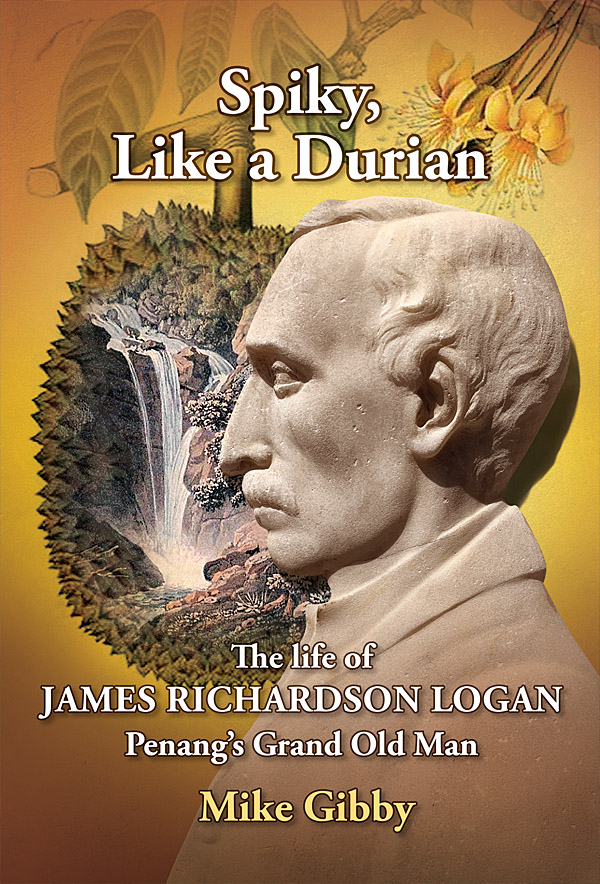
Designing the cover of "Spiky, Like a Durian"
There are no known surviving photographs or painted portraits of James Richardson Logan, nor of his son Daniel or his brother Abraham. What remains instead is a bas-relief memorial portrait, erected by the legal fraternity of Penang in early 1872, just over two years after Logan’s death on 20 October 1869.
Given the short interval between his passing and the construction of the memorial, it is highly likely that family members, close friends, or professional colleagues supplied images or visual references of Logan for the stone mason to work from. The resulting sculpture is therefore not a frozen moment, but a constructed memory. It reflects how Logan was understood by those who knew him and those who sought to honour him, as a figure of reason, permanence, and civic consequence. In this sense, the memorial portrait carries a truth that no imagined painting could achieve. It is Penang’s own remembrance of the man, and it is this austere sculptural profile that anchors the cover of this book.
Yet Logan was never static.
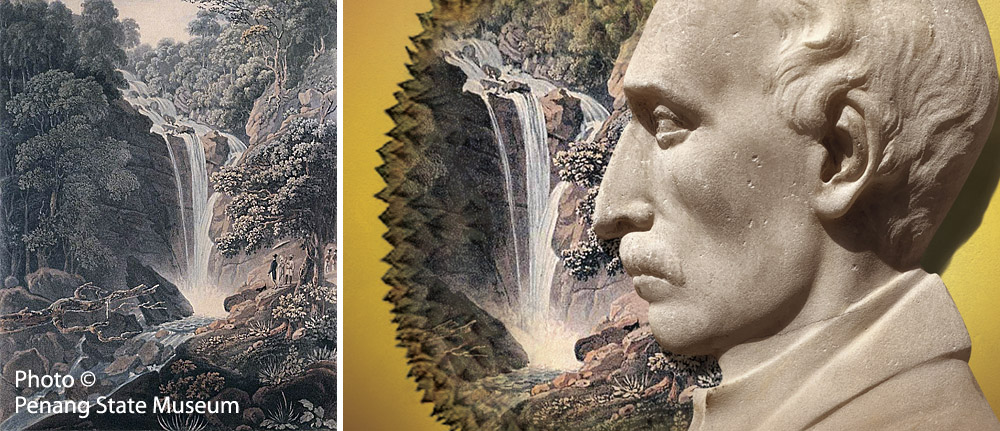
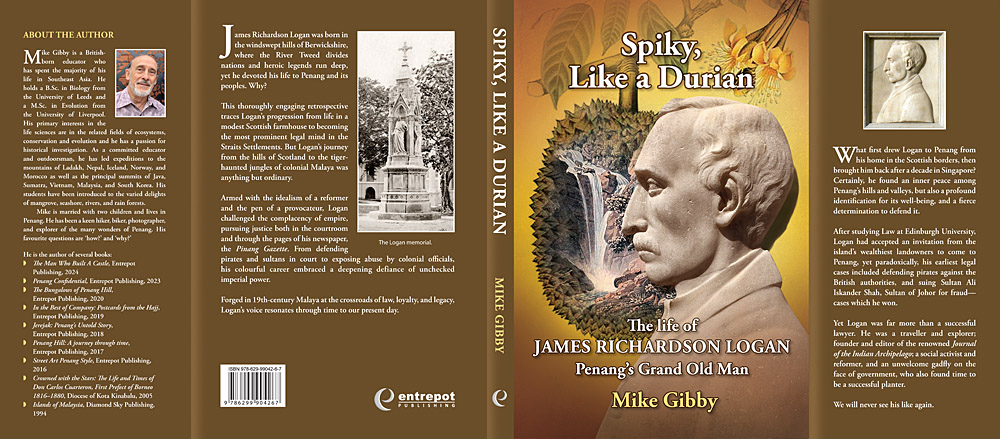
Behind the stillness of stone, the cover also incorporates movement through "View of the Cascade from Panoramic Sketch of Prince of Wales Island", a waterfall painted by William Daniell (after Captain Robert Smith) in 1821. Created in the very era in which Logan’s intellectual character was being formed, the image situates him within the natural world that so deeply animated his writing, a world he observed with scientific attentiveness and defended with moral urgency.
Long before “environmentalism” had a name, Logan wrote passionately about forests, rivers, landscapes, and the destructive consequences of colonial extraction. In the pages of the Journal of the Indian Archipelago and Eastern Asia and the Pinang Gazette, nature is never mere scenery; it is evidence, inheritance, and responsibility. The waterfall, endlessly flowing, becomes a metaphor for his mind: persistent, shaping, eroding complacency through time.
The durian, illustrated on the cover is both a literal frame for the painting and a textural and symbolic force, reflects Logan’s reputation among contemporaries and adversaries alike. He was intellectually formidable, uncompromising, and often deeply uncomfortable to those in power. As the private letters of Dr John Bishop King attest, Logan provoked hostility as readily as admiration. Yet, like the fruit itself, those who penetrated the outer thorny armour encountered substance, nourishment, and complexity.
Why Penang? Why So Young?
Logan’s journey from the Scottish Borders to Southeast Asia was neither accidental nor merely professional. Born in Berwickshire, a borderland shaped by contested authority, layered identities, and long memories of injustice, he matured early into a thinker drawn to questions of law, governance, and moral responsibility.
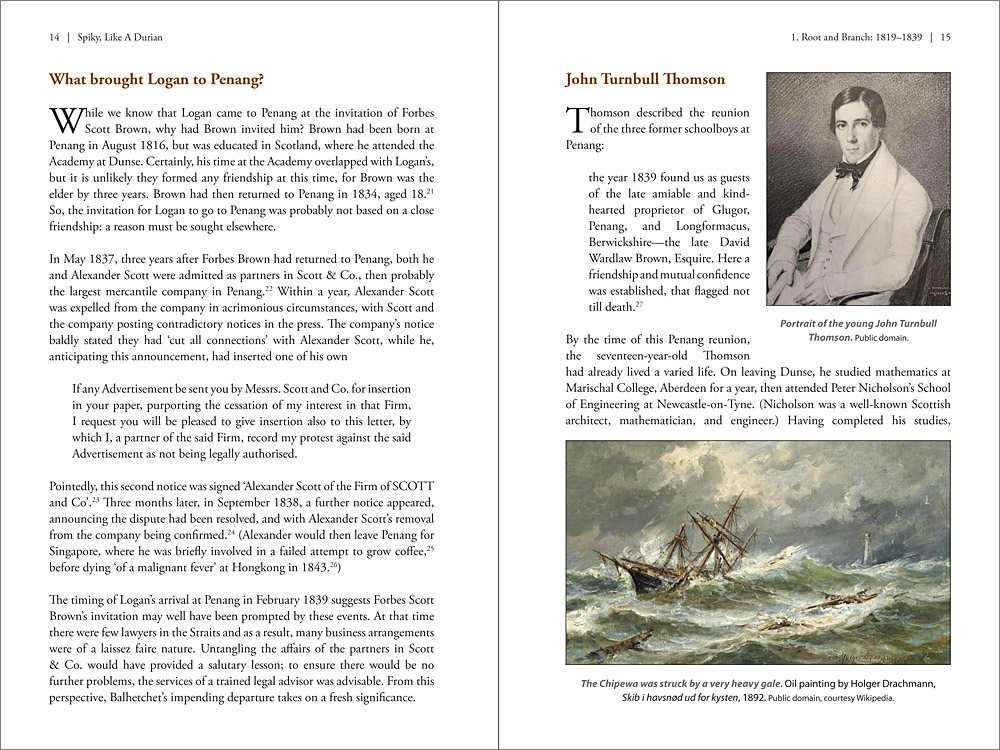
At the age of fourteen, Logan left home for Edinburgh, where he began formal studies in law. By his late teens, he had already travelled widely, and by his early twenties he had absorbed the reformist spirit of his age. As his lifelong friend John Turnbull Thomson later recalled, Logan was driven less by ambition than by ideas, by a belief that knowledge, rigorously pursued and publicly expressed, could improve society.
The Straits Settlements offered what Britain could not: a living laboratory in which law, empire, culture, and environment collided daily. In 1839, Logan aged 20 arrived in Penang. He came not as a passive colonial functionary, but as an engaged observer with a strong sense of purpose. His early legal practice soon expanded into journalism, scholarship, and advocacy, as he immersed himself in the intellectual and civic life of the settlement.

In this context, the durian flower placed on the cover assumes quiet significance. Rarely seen, fragrant, and short-lived, it represents potential rather than impact. Upon pollination, followed by fertilisation, it develops slowly and inevitably into the formidable, thorn-covered fruit. The image mirrors Logan’s own trajectory. What arrived in Penang was not yet the spiky public intellectual he would become, but the flowering of a mind shaped by curiosity, discipline, and conviction.
In Penang, Logan found both inspiration and resistance, forces that sharpened his intellect and hardened his convictions. Over time, the idealistic young reformer matured into the formidable editor of the Pinang Gazette, fearless in confronting abuses of power, defending marginalised voices, and insisting that justice must apply equally to Europeans and locals alike. Penang became his home, the place where early promise took root, where ideas were tested, and where a complex and enduring legacy was formed.
A Visual Synthesis
The warm golden palette, a colour of great value, evokes age, memory, and heritage, anchoring the narrative in the past while inviting contemporary readers to reconsider Logan’s relevance today. Set in Adobe Garamond Pro, the formal typography reflects the book's gravity while allowing the imagery to carry its emotional resonance.
The cover reflects a design of synthesis, not merely a portrait. Stone and water. Stillness and movement. Intellect and environment. Scotland’s son and Penang’s Grand Old Man. Like its subject, the cover does not seek to be agreeable. It seeks to be true.
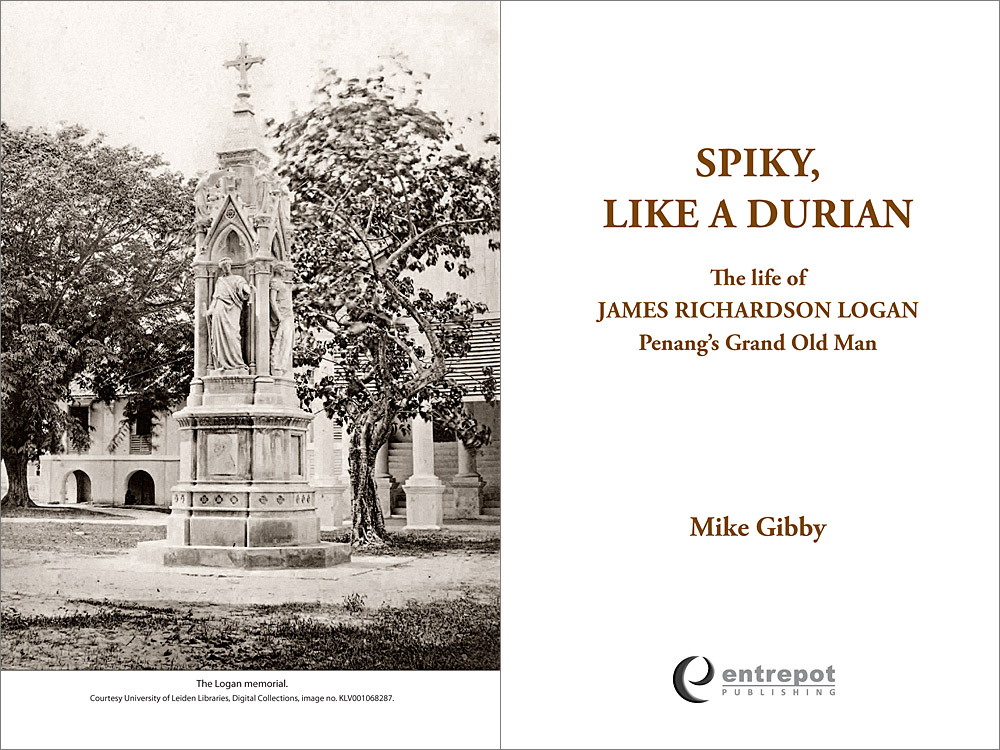
If this cover has caught your attention, it has already done its work. It offers clues rather than conclusions. Inside, the story deepens, demanding more than archival diligence. It requires a guide who understands landscape, history, ecology, and human motive as interwoven forces.
The Guide
That guide is Mike Gibby. A British-born educator who has spent most of his life in Southeast Asia, he brings a rare combination of scientific training, historical curiosity, and lived familiarity with Penang’s terrain. His background in biology sharpens his sensitivity to ecosystems and environmental change; his years as a teacher and expedition leader give him an instinct for narrative movement, context, and discovery.
Mike writes as someone who walks the ground he describes. As a hiker, photographer, and long-time observer of Penang’s hills, forests, and shorelines, he understands the landscapes that shaped Logan’s thinking. As a historian, he is meticulous and fair-minded, drawing from journals, newspapers, memoirs, and contemporaneous accounts to reconstruct a life that left few personal traces but many public imprints.
I have had the privilege of working with Mike on several of his books, and each collaboration confirms the same truth: he is a storyteller who respects his reader. He does not simplify complexity or sensationalise conflict; he invites the reader to think alongside him—to ask, as he always does, how and why.
"Spiky, Like a Durian" is more than a biography. It explores conscience under pressure, law as both instrument and ideal, and a man whose sharpness was inseparable from his integrity. Like its subject, the book is unafraid to be challenging. And, like the durian itself, those willing to look beyond the surface will discover more.
-------------------------------------
Written by Adrian Cheah
© All rights reserved
29 January 2026
James Richardson Logan
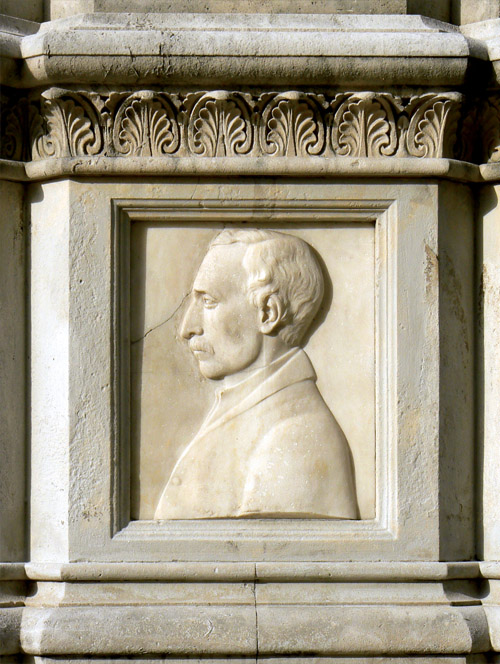
What first drew Logan to Penang from his home in the Scottish borders, then brought him back after a decade in Singapore? Certainly, he found an inner peace among Penang’s hills and valleys, but also a profound identification for its well-being, and a fierce determination to defend it.
After studying Law at Edinburgh University, Logan had accepted an invitation from the island’s wealthiest landowners to come to Penang, yet paradoxically, his earliest legal cases included defending pirates against the British authorities, and suing Sultan Ali Iskander Shah, Sultan of Johor for fraud—cases which he won.
Yet Logan was far more than a successful lawyer. He was a traveller and explorer; founder and editor of the renowned Journal of the Indian Archipelago; a social activist and reformer, and an unwelcome gadfly on the face of government, who also found time to be a successful planter.
We will never see his like again.
Spiky, Like a Durian
The life of James Richardson Logan—Penang’s Grand Old Man
By Mike Gibby
January 2026, Entrepot Publishing Sdn Bhd
Hardcover. 15.24 cm x 22.86 cm, 244 pages
Language: English
Illustrated throughout
Genre: Non-fiction, history
ISBN 978-629-99042-6-7
Available at https://entrepotpublishing.com/
-------------------------------------
About the Author

Mike Gibby is a British-born educator who has spent the majority of his life in Southeast Asia. He holds a B.Sc. in Biology from the University of Leeds and a M.Sc. in Evolution from the University of Liverpool. His primary interests in the life sciences are in the related fields of ecosystems, conservation and evolution and he has a passion for historical investigation. As a committed educator and outdoorsman, he has led expeditions to the mountains of Ladakh, Nepal, Iceland, Norway, and Morocco as well as the principal summits of Java, Sumatra, Vietnam, Malaysia, and South Korea. His students have been introduced to the varied delights of mangrove, seashore, rivers, and rain forests.
Mike is married with two children and lives in Penang. He has been a keen hiker, biker, photographer, and explorer of the many wonders of Penang. His favourite questions are ‘how?’ and ‘why?’
He is the author of several books:
- The Man Who Built A Castle, Entrepot Publishing, 2024
- Penang Confidential, Entrepot Publishing, 2023
- The Bungalows of Penang Hill, Entrepot Publishing, 2020
- In the Best of Company: Postcards from the Hajj, Entrepot Publishing, 2019
- Jerejak: Penang’s Untold Story, Entrepot Publishing, 2018
- Penang Hill: A journey through time, Entrepot Publishing, 2017
- Street Art Penang Style, Entrepot Publishing, 2016
- Crowned with the Stars: The Life and Times of Don Carlos Cuarteron, First Prefect of Borneo 1816–1880, Diocese of Kota Kinabalu, 2005
- Islands of Malaysia, Diamond Sky Publishing, 1994